Analytical Psychology
Founded a school emphasizing archetypes, individuation, and the collective unconscious.
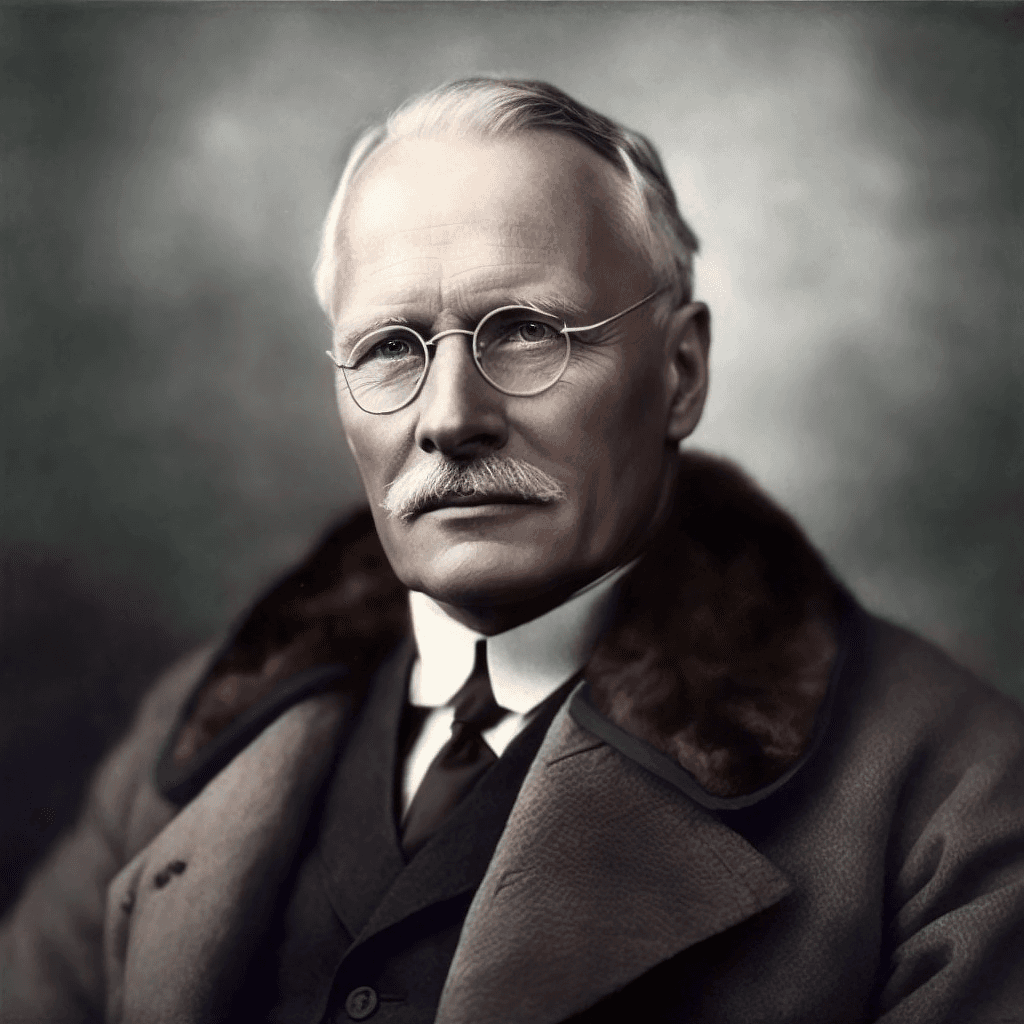
1875–1961
Psychiatrist • Analytical Psychology Pioneer
Carl Gustav Jung was born on 26 July 1875 in Kesswil, Thurgau canton, Switzerland, son of Paul Jung, a Swiss Reformed pastor, and Emilie Preiswerk, whose depressive episodes and séance interests unsettled childhood home. An isolated childhood—sibling death, parental tension, vivid dreams he later analyzed—fed lifelong interest in inner imagery and myth. He studied medicine at the University of Basel, choosing psychiatry when reading Krafft-Ebing's textbook convinced him mental disease combined biological mystery and human meaning. In 1900 he joined Burgholzli psychiatric hospital in Zurich under Eugen Bleuler, who coined schizophrenia and fostered research environment linking clinical observation to experimental psychology. Jung's word-association tests measured reaction times and disturbances when patients responded to stimulus words, revealing unconscious emotional complexes that became cornerstone of his early reputation. He published Studies in Word Association and sent copies to Sigmund Freud in Vienna, initiating correspondence that led to intense collaboration from 1907. Freud saw Jung as scientific heir who could lend psychiatry respectability beyond Viennese circles; Jung admired Freud's courage uncovering sexuality yet harbored doubts about pansexual reductionism. Jung married Emma Rauch in 1903; she became analyst and editor, managing household while Carl traveled and Emma developed her own intellectual work often overshadowed in biographies. Swiss neutrality and Zurich's cosmopolitan medical community positioned Jung between German and Anglo-American psychiatric networks at a pivotal moment for psychoanalysis's global spread.
Differences over sexuality, religion, and the nature of the unconscious culminated in break around 1913 after Jung published Psychology of the Unconscious, developing symbols Freud interpreted as defensive sublimation. Jung entered period of intense self-experimentation recorded in Liber Novus, later published as The Red Book, documenting visions, dialogues with inner figures, and mythic imagery he considered empirical data of psyche. He developed analytical psychology proposing collective unconscious shared across humanity, populated by archetypes—shadow, anima, animus, wise old man, mother—recurring symbols in dreams, myths, and religions. Psychological Types, published 1921, defined introversion and extraversion plus four functions—thinking, feeling, sensation, intuition—framework later adapted by Isabel Briggs Myers into Myers-Briggs Type Indicator widely used in corporate settings. Jung traveled to India, Tunisia, Kenya, New Mexico pueblo, studying myths and rituals, arguing modern alienation stemmed from loss of symbolic ritual in secular industrial societies. He advised statesmen and writers yet avoided partisan politics, maintaining clinic in Küsnacht on Lake Zurich until death. Eranos conferences in Ascona brought scholars of religion, alchemy, and mysticism into dialogue with Jungian analysts, spreading ideas through humanities as well as clinics. Critics questioned scientific testability of archetypes and accused essentializing of cultures; defenders argue he offered heuristic models rather than laboratory hypotheses. His friendship and break with Freud became foundational narrative in history of psychoanalysis, dramatized in theater and film.
Jung died on 6 June 1961 in Küsnacht after heart failure following short illness, leaving vast correspondence and unpublished manuscripts managed by heirs sometimes restrictively. Posthumous Red Book publication in 2009 renewed public fascination with his visionary method. Jung widened psychotherapy to include myth, religion, and cross-cultural symbolism, influencing artists from Hermann Hesse to Jackson Pollock and filmmakers using archetypal language. Typologies permeate corporate training and popular personality tests despite psychologists' warnings about validity. By treating dreams and fantasies as meaningful data, he shifted mental health discourse toward narrative and meaning even as scientists debate empirical status of archetypal claims. Religious studies programs cite his synchronicity concept—meaningful coincidence—as bridge between psychology and spirituality. National Socialism's rise forced painful questions about some German colleagues and Jung's presidency of International General Medical Society for Psychotherapy during early Nazi period, a controversy scholars continue to examine. Clinical Jungian institutes operate worldwide, offering training distinct from Freudian and cognitive traditions. Literary criticism employs archetypal reading partly through his vocabulary. Jung reframed mental illness as dialogue between ego and deeper psyche, expanding psychiatry beyond nineteenth-century somatic models and leaving a contested but durable imprint on how modern cultures interpret inner life. Art therapists cite archetypal imagery when guiding clients through mandala drawing, extending clinical methods beyond traditional talk therapy. Digital humanities projects map Jung's travel photographs and field notes alongside comparative religion lectures at Eranos. Debates over unpublished letter restrictions continue between estate trustees and scholars seeking full access to correspondence with Wolfgang Pauli and other physicists on synchronicity. Undergraduate psychology surveys still assign Psychological Types when introducing personality theory's historical roots. Clinical training programs review his case seminars when teaching symbolic interpretation of dreams in psychodynamic psychotherapy. Museums in Küsnacht exhibit his library and study, presenting analytical psychology as part of twentieth-century intellectual history rather than fringe mysticism alone. Continental philosophy seminars discuss his break with Freud when teaching twentieth-century theories of subjectivity, religion, and the unconscious in comparative perspective. Analytical training institutes require study of his typological framework even as empirical psychologists question its measurement validity. Readers and researchers continue to consult biographies, correspondence, and archival collections when reconstructing the context of these achievements.
1875 — Born in Kesswil. Born in Thurgau canton to a Swiss Reformed pastoral family.
1907 — Collaboration with Freud. Met Sigmund Freud in Vienna, beginning a partnership that dominated early psychoanalysis.
1913 — Break with Freud. Ended collaboration after disputes over libido theory and the unconscious.
1921 — Psychological Types Published. Released a major work on personality functions and attitudes.
1961 — Death in Kusnacht. Died in Kusnacht after decades of clinical practice and writing.
Key moments across this figure's life and legacy
1875
Born in Thurgau canton to a Swiss Reformed pastoral family.
1907
Met Sigmund Freud in Vienna, beginning a partnership that dominated early psychoanalysis.
1913
Ended collaboration after disputes over libido theory and the unconscious.
1921
Released a major work on personality functions and attitudes.
1961
Died in Kusnacht after decades of clinical practice and writing.
Landmarks that define this figure's contribution to history
Founded a school emphasizing archetypes, individuation, and the collective unconscious.
Used reaction-time studies at Burgholzli to map unconscious emotional complexes.
Published a typology of introversion and extraversion that shaped later personality frameworks.
Documented visionary experiences that informed his mythic approach to therapy and culture.
Notable details about this historical figure
How this figure shaped the world we inherit
Jung widened psychotherapy to include myth, religion, and cross-cultural symbolism, influencing artists from Hermann Hesse to Jackson Pollock. His typologies permeate corporate training and popular personality tests. By treating dreams and fantasies as meaningful data, he helped shift mental health discourse toward narrative and meaning, even as scientists debate the empirical status of his archetypal claims.
Enduring influence across generations
Jung widened psychotherapy to include myth, religion, and cross-cultural symbolism, influencing artists from Hermann Hesse to Jackson Pollock. His typologies permeate corporate training and popular personality tests. By treating dreams and fantasies as meaningful data, he helped shift mental health discourse toward narrative and meaning, even as scientists debate the empirical status of his archetypal claims. Death in Kusnacht (1961) remains a defining moment in Carl Gustav Jung's enduring reputation.
Explore more profiles from the same era or field
Curated educational resources for further study
Start a private conversation and explore their wisdom through Historical Collection AI.