Carolingian Empire
United Frankish, Lombard, and Saxon territories into the largest western European state since Rome.
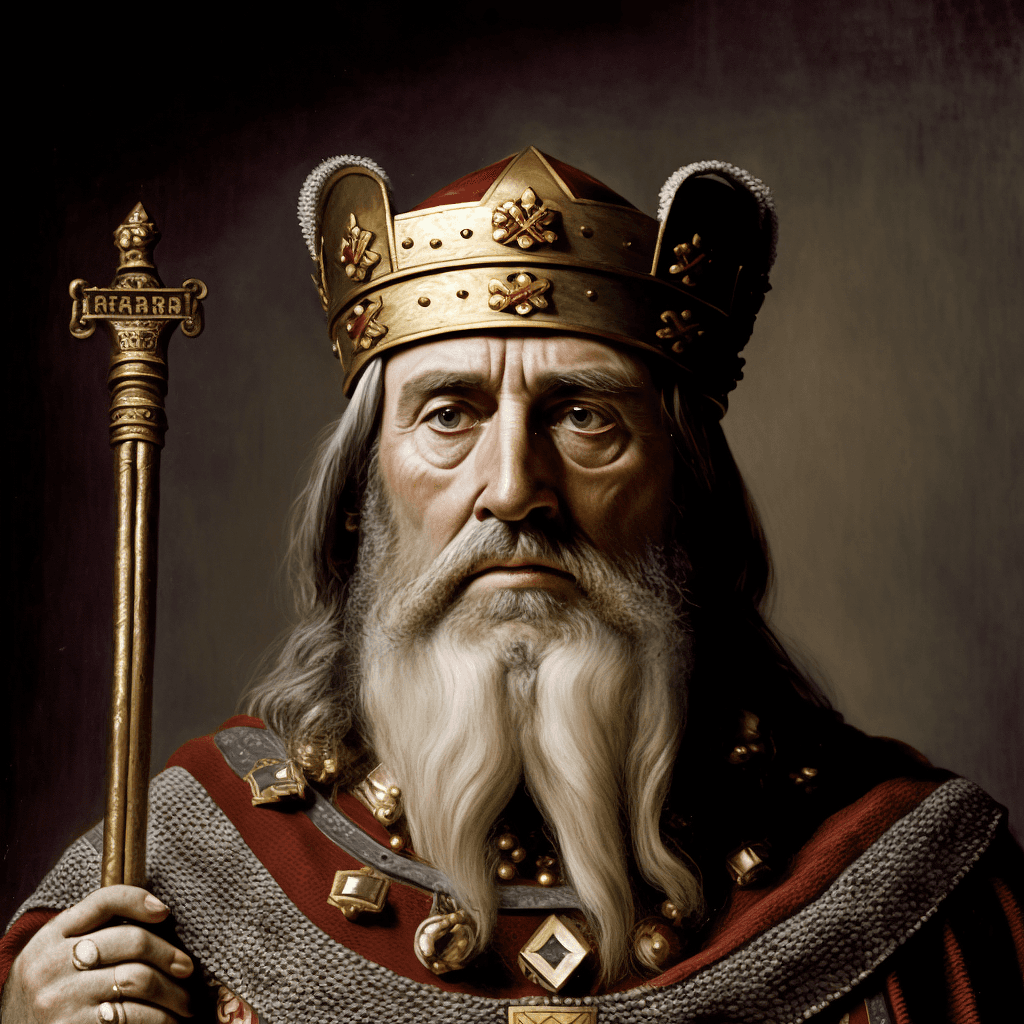
747–814
Emperor • Unifier • Medieval Ruler
Charlemagne, Charles the Great, was born around 747, likely near Liège in the Frankish heartland, son of Pepin the Short, who deposed the last Merovingian king with papal blessing and founded the Carolingian royal line. Charles and brother Carloman inherited joint rule in 768 upon Pepin's death, dividing Francia until Carloman's death in 771 left Charles sole king of the Franks. Frankish society combined Germanic warrior aristocracy, Christian clergy, and remnants of Roman administrative vocabulary; young Charles trained in horsemanship, weaponry, and alliance politics through annual military campaigns. Marriage alliances and division of spoils bound nobles to crown while risking rebellion if rewards failed. Charles was physically imposing according to Einhard's biography, devoted to hunting, swimming, and learning later in life despite modest early literacy. The papacy, threatened by Lombards in Italy and Byzantine limits, sought Frankish protectors who could defend Rome and advance orthodox Christianity against heresy and pagan practice on frontiers. Saxon territories east of Rhine remained pagan and resistant to tribute; Charles would wage decades of campaigns there, incorporating forced baptism and mass deportations historians now analyze as cultural genocide as well as state formation. Spanish March expeditions against Umayyad al-Andalus produced Roland legends later romanticized in Song of Roland, though historical Roncevaux Pass was rear-guard defeat not triumph. By 800 Charles ruled much of Western Europe beyond any single authority since late Rome.
On Christmas Day 800, Pope Leo III crowned Charles emperor in Saint Peter's Basilica, Rome, reviving an imperial title in the West and linking kingship to papal sanction in ceremony whose spontaneity Einhard questioned but political meaning was clear. Charlemagne governed through missi dominici, royal envoys inspecting counts, and capitularies— legislative decrees on church reform, coinage, education, military service, and manor economy—attempting uniform Christian governance across diverse regions. At Aachen he built palace chapel inspired by San Vitale in Ravenna, using architecture to assert Roman-Christian imperial aesthetics. Court scholars led by Alcuin of York from 782 promoted Carolingian Renaissance: standardized Caroline minuscule script improving manuscript legibility, monastic schools, copying of classical and patristic texts preserving learning through early medieval centuries. Einhard's Life of Charlemagne portrays a ruler who collected barbarian laws, revised liturgy, and debated theology with clerics while dining modestly in great hall. Economically, Charles encouraged silver penny coinage, weights and measures reform, and bridge and road maintenance tied to royal power. Relations with Abbasid caliph Harun al-Rashid included elephant Abul-Abbas gift, symbolizing diplomatic reach. Border warfare continued against Vikings in north, Avars in east, and internal revolts such as sons' rebellions testing succession. Imperial title strained relations with Byzantium, which claimed exclusive Roman emperorship, yet practical governance remained Frankish and Germanic in custom.
Charlemagne died on 28 January 814 in Aachen after a reign of over four decades, leaving empire to son Louis the Pious; later division among grandsons and Treaty of Verdun 843 split realms foreshadowing France and Germany. Medieval chronicles idealized him as Christian warrior-king; later Holy Roman Emperors claimed his mantle for centuries. Carolingian manuscript culture preserved texts of Virgil, Augustine, and Roman law that might otherwise have vanished in post-Roman fragmentation. Historians debate depth of his personal literacy—Einhard says he learned writing late and kept tablets under pillow—but cultural program attached to his name altered Western Europe's intellectual landscape. Charlemagne redefined European political space by joining Germanic kingship, Roman imperial titles, and Christian mission. European Union institutions occasionally invoke him as symbol of continental unity, contested by nationalist historians emphasizing fragmentation after his death. Archaeology at Aachen and Ingelheim continues refining image of court life and trade networks. Feudal governance models trace partly to Carolingian grants of immunity and benefices to nobles in exchange for service. His fusion of sword and scripture shaped European political theology for medieval crusades and sacral kingship theories. Charlemagne remains a pivot between ancient Rome and medieval Europe, a ruler whose empire was shorter-lived than his cultural shadow. Carolingian minuscule manuscripts in national libraries from Paris to Vienna remain primary sources for classicists recovering Roman texts. Archaeologists at Aachen excavate palace complex layers revealing trade goods from Baltic amber to Islamic silver. Comparative constitutional historians contrast Charlemagne's capitularies with later Magna Carta traditions, tracing long arcs of written royal obligation in Europe. European integration rhetoric occasionally invokes his empire as precedent for unity amid linguistic and legal diversity. Medieval history podcasts and public lectures regularly revisit his coronation as turning point between ancient and medieval political imagination. School textbooks across Europe still introduce feudalism and monastic learning through Carolingian examples anchored on his reign and court reforms. Art historians analyze ivory diptychs and manuscript illuminations from his reign as visual propaganda for Christian empire, connecting material culture to political theology of sacral kingship. University medieval surveys use his capitularies to show how rulers attempted standardized governance across linguistically diverse territories. Readers and researchers continue to consult biographies, correspondence, and archival collections when reconstructing the context of these achievements.
747 — Born a Carolingian. Born into the ruling family of the Franks, son of Pepin the Short.
768 — Became King of the Franks. Succeeded Pepin, initially sharing rule with his brother Carloman.
774 — Conquest of Lombard Italy. Defeated the Lombard kingdom and took the Iron Crown of Italy.
800 — Crowned Emperor. Crowned by Pope Leo III in Rome on Christmas Day.
814 — Death at Aachen. Died in Aachen after a reign of over four decades.
Key moments across this figure's life and legacy
747
Born into the ruling family of the Franks, son of Pepin the Short.
768
Succeeded Pepin, initially sharing rule with his brother Carloman.
774
Defeated the Lombard kingdom and took the Iron Crown of Italy.
800
Crowned by Pope Leo III in Rome on Christmas Day.
814
Died in Aachen after a reign of over four decades.
Landmarks that define this figure's contribution to history
United Frankish, Lombard, and Saxon territories into the largest western European state since Rome.
Received imperial crown from Pope Leo III, reviving Western emperorship.
Patronized schools and manuscript production that preserved classical and Christian texts.
Issued legal and moral decrees standardizing coinage, church discipline, and royal oversight.
Notable details about this historical figure
How this figure shaped the world we inherit
Charlemagne redefined European political space by joining Germanic kingship, Roman imperial titles, and Christian mission. His court's manuscript culture preserved texts that might otherwise have vanished, anchoring medieval education. The memory of his empire fed later French and German statehood, Holy Roman politics, and the idea of a united Christian West—an inheritance still invoked in debates over European integration.
Enduring influence across generations
Charlemagne redefined European political space by joining Germanic kingship, Roman imperial titles, and Christian mission. His court's manuscript culture preserved texts that might otherwise have vanished, anchoring medieval education. The memory of his empire fed later French and German statehood, Holy Roman politics, and the idea of a united Christian West—an inheritance still invoked in debates over European integration. Death at Aachen (814) remains a defining moment in Charlemagne's enduring reputation.
Explore more profiles from the same era or field
Curated educational resources for further study
Start a private conversation and explore their wisdom through Historical Collection AI.