Founding the People's Republic
Led the Communist Party to victory in 1949 and proclaimed the People's Republic of China.
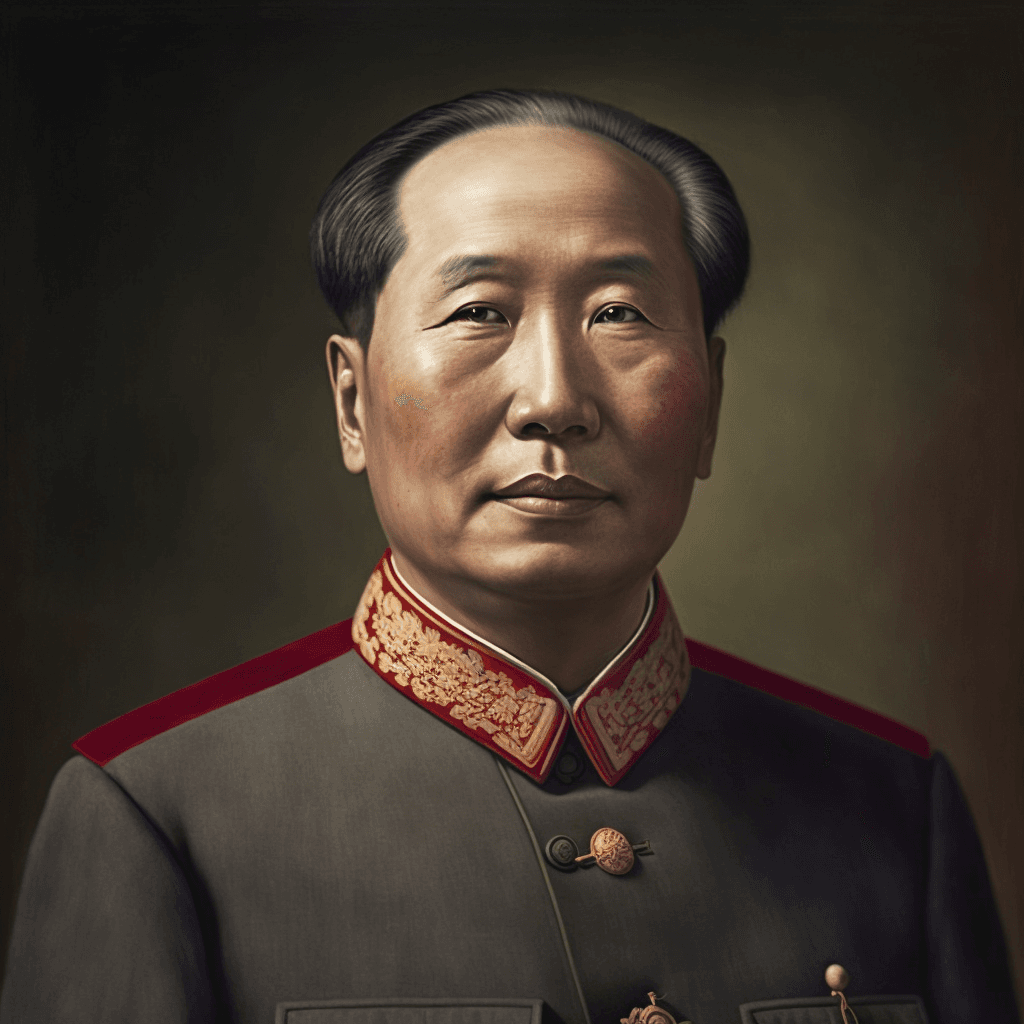
1893–1976
Revolutionary • Founder of the People's Republic of China
Mao Zedong was born on 26 December 1893 in Shaoshan, a village in Hunan Province, into a prosperous peasant family that nonetheless sat at the margins of China's literati elite. He studied briefly at schools in Changsha, worked as a library assistant at Peking University where he encountered Marxist texts, and joined early Communist organizing in the 1920s amid warlord fragmentation and foreign imperial pressure. The Long March of 1934–1935, a strategic retreat of Communist forces across thousands of miles, cemented his leadership within the party and mythologized his role as survivor and strategist. During the war against Japan and the subsequent civil war with the Nationalists, Mao adapted guerrilla doctrine to Chinese conditions, emphasizing peasant mobilization rather than urban proletarian insurrection alone.
On 1 October 1949 Mao proclaimed the People's Republic of China from Tiananmen Gate in Beijing, ending decades of civil conflict and foreign occupation in the mainland while the Nationalist government retreated to Taiwan. His early policies included land reform, marriage law revision, and campaigns against opium use and illiteracy, but also political purges that targeted landlords, intellectuals, and perceived counterrevolutionaries. The Great Leap Forward (1958–1962) attempted rapid industrialization and collectivization, producing famine that historians estimate killed tens of millions. The Cultural Revolution (1966–1976) mobilized Red Guards against party institutions, schools, and cultural heritage, leaving social trauma and economic disruption. Mao retained paramount authority until his death, balancing factional rivals and presenting himself as the embodiment of continuous revolution.
Mao died on 9 September 1976 in Beijing, and successors gradually repudiated many of his campaigns while preserving his image as founding leader. His Selected Works and Little Red Book circulated globally among leftist movements from Algeria to Peru, shaping revolutionary rhetoric far beyond China. Economically, the reforms launched after his death transformed China into an industrial powerhouse, yet political control remained rooted in party structures he consolidated. Historians debate how to weigh anti-imperial unification and social reform against catastrophic policy failures and authoritarian repression. For Chinese society, Mao's portraits and mausoleum remain visible symbols of a contested twentieth century, and scholarship continues to document famine mortality, labor camps, and the human cost of mass mobilization politics.
1893 — Born in Shaoshan. Born in Hunan Province into a peasant family during the late Qing dynasty.
1935 — Long March. Emerged as paramount leader after the Communist retreat across western China.
1949 — Proclamation of the PRC. Declared the founding of the People's Republic of China from Tiananmen.
1966 — Cultural Revolution Launched. Initiated mass political mobilization that upended schools, culture, and party institutions.
1976 — Death in Beijing. Died at eighty-two, ending an era of continuous revolutionary campaigns.
Key moments across this figure's life and legacy
1893
Born in Hunan Province into a peasant family during the late Qing dynasty.
1935
Emerged as paramount leader after the Communist retreat across western China.
1949
Declared the founding of the People's Republic of China from Tiananmen.
1966
Initiated mass political mobilization that upended schools, culture, and party institutions.
1976
Died at eighty-two, ending an era of continuous revolutionary campaigns.
Landmarks that define this figure's contribution to history
Led the Communist Party to victory in 1949 and proclaimed the People's Republic of China.
Consolidated party leadership during the 1934–1935 retreat that preserved the Communist movement.
Adapted Marxist strategy to rural mobilization and guerrilla warfare in a predominantly agrarian society.
Implemented land redistribution, literacy campaigns, and legal changes affecting women and family structure.
Notable details about this historical figure
How this figure shaped the world we inherit
Mao unified mainland China under Communist rule and inspired revolutionary movements worldwide, yet his mass campaigns caused famine and social upheaval whose human toll remains central to modern Chinese memory. Post-Mao economic reforms transformed the country he founded while leaving his political model contested, making him one of the twentieth century's most consequential and controversial rulers.
Enduring influence across generations
Mao unified mainland China under Communist rule and inspired revolutionary movements worldwide, yet his mass campaigns caused famine and social upheaval whose human toll remains central to modern Chinese memory. Post-Mao economic reforms transformed the country he founded while leaving his political model contested, making him one of the twentieth century's most consequential and controversial rulers. Death in Beijing (1976) remains a defining moment in Mao Zedong's enduring reputation.
Explore more profiles from the same era or field
Curated educational resources for further study
Start a private conversation and explore their wisdom through Historical Collection AI.