Laws of Motion
Three principles forming the foundation of classical mechanics and engineering.
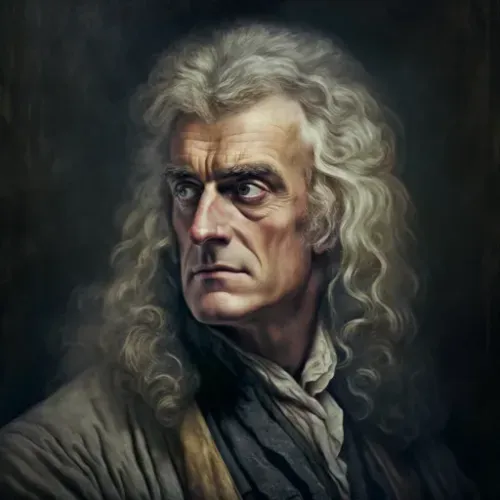
1643–1727
Mathematician • Physicist • Astronomer
Isaac Newton est né à Woolsthorpe, en Angleterre, au milieu des turbulences de la guerre civile et de la Révolution scientifique. Élève solitaire et intensément concentré, il entra à l'Université de Cambridge et traversa plus tard les années de peste en développant les fondements du calcul et en réalisant des expériences sur la lumière. Son génie combinait abstraction mathématique et conviction que les lois de la nature pouvaient être lues par l'observation et la mesure.
En 1687, il publia les Philosophiæ Naturalis Principia Mathematica, présentant trois lois du mouvement et la loi de la gravitation universelle. Les Principia montrèrent que la même force régissant la chute d'une pomme gouverne également l'orbite de la Lune, unifiant la mécanique terrestre et céleste. Le travail de Newton sur l'optique démontra que la lumière blanche se compose d'un spectre de couleurs, remettant en question les théories dominantes.
Anobli et nommé Maître de la Monnaie, Newton poursuivit également l'alchimie et la théologie—des domaines qui révèlent l'ampleur de ses recherches. Bien que des physiciens ultérieurs aient révisé son cadre, en particulier à des vitesses et échelles extrêmes, la mécanique newtonienne est devenue le socle de l'ingénierie, de l'astronomie et de la pensée des Lumières, lui valant une place parmi les esprits les plus influents de l'histoire.
Moments clés de la vie et de l'héritage de cette figure
1643
Born prematurely in Lincolnshire; his father died before his birth.
1665–1666
During plague closures, advanced calculus, optics, and gravitation ideas.
1687
Released Mathematical Principles of Natural Philosophy, reshaping science.
1704
Published major work on light, color, and experimental method.
1727
Buried in Westminster Abbey as a national hero of the Enlightenment.
Jalons qui définissent la contribution de cette figure à l'histoire
Three principles forming the foundation of classical mechanics and engineering.
Showed that all masses attract one another, explaining planetary orbits and tides.
Developed infinitesimal calculus independently, enabling modern mathematical physics.
Landmark 1687 treatise that systematized natural philosophy for generations.
Détails notables sur cette figure
Comment cette figure a façonné le monde que nous avons hérité
La synthèse de Newton entre mathématiques et physique a donné à l'Âge des Lumières un modèle d'univers rationnel régi par des lois. Les ingénieurs ont construit la Révolution industrielle sur ses mécaniques ; les astronomes ont cartographié le système solaire avec sa gravitation ; les philosophes l'ont cité comme preuve que la raison humaine pouvait déchiffrer la nature. Même après Einstein, Newton reste essentiel pour la plupart des sciences quotidiennes—de la conception de ponts aux trajectoires de vol spatial.
Influence durable à travers les générations
Newton's synthesis of mathematics and physics gave the Enlightenment a model of a rational, law-governed universe. Engineers built the Industrial Revolution on his mechanics; astronomers mapped the solar system with his gravitation; philosophers cited him as proof that human reason could decode nature. Even after Einstein, Newton remains essential for most everyday science—from bridge design to spaceflight trajectories. Death in London (1727) remains a defining moment in Isaac Newton's enduring reputation.
D'autres profils de la même époque ou du même domaine
Ressources éducatives sélectionnées pour approfondir
Entamez une conversation privée via Historical Collection AI.