Special Relativity
Revolutionized concepts of space, time, and simultaneity; introduced mass–energy equivalence.
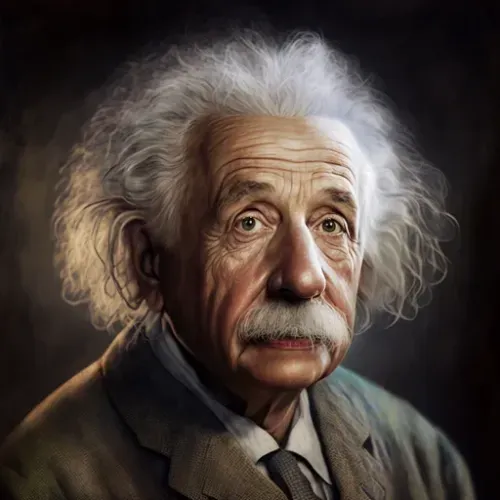
1879–1955
Physicist • Thinker • Humanist
Альберт Эйнштейн (Albert Einstein) родился в Ульме, Германия, и с раннего возраста проявлял любопытство к природе и абстрактному мышлению, хотя его нестандартный путь через школу и Швейцарскую политехнику опровергал революцию, которую он позже зажжет. После многих лет работы в качестве патентного клерка в Берне он опубликовал ряд статей в 1905 году — его annus mirabilis — которые изменили понимание света, материи и энергии.
Специальная относительность объединила пространство и время и установила, что скорость света постоянна для всех наблюдателей, что привело к знаменитому уравнению E=mc². Общая относительность, завершенная в 1915 году, переосмыслила гравитацию не как силу, действующую в пустом пространстве, а как искривление пространства-времени, вызванное массой и энергией. Эта теория предсказала такие явления, как искривление света звезд и гравитационные волны, которые позже были подтверждены наблюдениями.
В 1921 году ему была присуждена Нобелевская премия за объяснение фотоэлектрического эффекта; Эйнштейн также помог заложить основы квантовой теории, известной своей дискуссией о ее интерпретации. Мирный активист, который позже предупреждал о ядерной опасности, он эмигрировал в Соединенные Штаты и провел последние десятилетия в Институте высших исследований, стремясь к единой теории поля и выступая за гражданские права и международное сотрудничество.
Ключевые моменты жизни и наследия этой личности
1879
Born to a middle-class Jewish family in the German Empire.
1905
Published papers on the photoelectric effect, Brownian motion, and special relativity.
1915
Presented field equations describing gravity as spacetime curvature.
1921
Awarded for services to theoretical physics, especially the photoelectric effect.
1955
Died in New Jersey, leaving a legacy as the twentieth century's emblem of scientific genius.
Вехи, определяющие вклад этой личности в историю
Revolutionized concepts of space, time, and simultaneity; introduced mass–energy equivalence.
Provided a new theory of gravitation, predicting black holes, lensing, and expanding cosmos.
Honored for the photoelectric effect, crucial to quantum theory and modern electronics.
Equations and insights that underpin modern cosmology, GPS technology, and astrophysics.
Примечательные детали об этой личности
Как эта личность изменила мир, который мы унаследовали
Эйнштейн сделал больше, чем просто продвинул физику — он изменил, как человечество представляет себе вселенную. Относительность разрушила абсолютное пространство и время, в то время как его вклад в квантовую физику открыл атомную эпоху. Его известность сделала науку общественным разговором, а его моральный голос по вопросам войны, расизма и ядерного оружия показал, что интеллектуальные достижения несут этическую ответственность. Сегодня его теории ежедневно проверяются в ускорителях частиц, телескопах и спутниках глобальной навигации.
Влияние на последующие поколения
Einstein did more than advance physics—he changed how humanity imagines the universe. Relativity dismantled absolute space and time, while his quantum contributions opened the atomic age. His celebrity made science a public conversation, and his moral voice on war, racism, and nuclear weapons showed that intellectual achievement carries ethical responsibility. Today his theories are tested daily in particle accelerators, telescopes, and the satellites of global navigation. Death in Princeton (1955) remains a defining moment in Albert Einstein's enduring reputation.
Другие профили той же эпохи или области
Подобранные образовательные ресурсы для дальнейшего изучения
Начните беседу и изучите мудрость через Historical Collection AI.