Declaration of Independence
Drafted the founding document articulating natural rights and colonial separation from Britain.
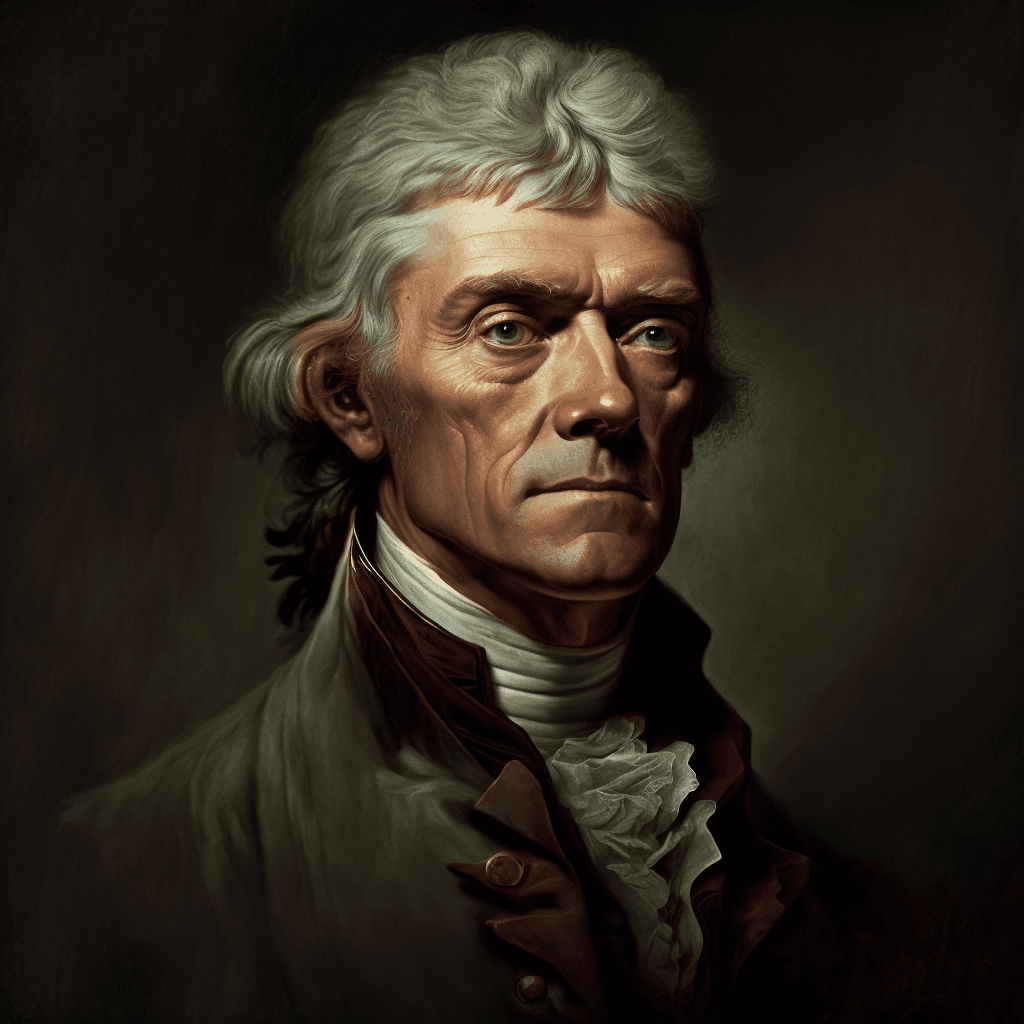
1743–1826
Founding Father • Author of the Declaration of Independence
Thomas Jefferson was born on 13 April 1743 at Shadwell plantation in Virginia's Piedmont, inheriting land and slaves while studying law under George Wythe and reading Locke, Newton, and classical republicans. He entered the Virginia House of Burgesses as imperial tensions rose, authored A Summary View of the Rights of British America, and in 1776 drafted the Declaration of Independence's ringing assertion that all men are created equal—a phrase whose universalism would be invoked by abolitionists, suffragists, and civil rights movements even as Jefferson himself owned hundreds of enslaved people.
As governor of Virginia during the Revolutionary War, Jefferson fled British raids; afterward he wrote the Virginia Statute for Religious Freedom and advocated education reform. Service as minister to France exposed him to salon culture and architectural fashions he later imported to Monticello and the University of Virginia. As George Washington's secretary of state he clashed with Alexander Hamilton over national bank and foreign alignment, founding Democratic-Republican opposition to Federalist centralization. Elected president in 1800 after a contentious electoral dispute, he oversaw the Louisiana Purchase doubling national territory, sent Lewis and Clark to explore the West, and reduced federal taxes while maintaining slavery's expansion economically.
Jefferson retired to Monticello in 1809, corresponded voluminously with John Adams and other founders, and founded the University of Virginia with secular curriculum and neoclassical campus he designed. He died on 4 July 1826, the fiftieth anniversary of the Declaration, hours before Adams. DNA and documentary evidence confirmed he fathered children with Sally Hemings, an enslaved woman at Monticello, forcing modern reckoning with his libertarian rhetoric and personal complicity in bondage. Jefferson's library rebuilt the Library of Congress after British burning in 1814; his Notes on the State of Virginia mixed scientific observation with racist speculation. He remains simultaneously symbol of democratic aspiration and embodiment of the republic's original contradiction between freedom and slavery.
1743 — Born at Shadwell. Born into Virginia planter society on the eve of empire and Enlightenment.
1776 — Declaration Authored. Wrote the Declaration of Independence adopted by the Continental Congress.
1801 — First Term as President. Inaugurated after the contentious election of 1800.
1803 — Louisiana Purchase. Negotiated purchase of French Louisiana, vastly expanding the nation.
1826 — Death on July Fourth. Died at Monticello on the Declaration's fiftieth anniversary.
Key moments across this figure's life and legacy
1743
Born into Virginia planter society on the eve of empire and Enlightenment.
1776
Wrote the Declaration of Independence adopted by the Continental Congress.
1801
Inaugurated after the contentious election of 1800.
1803
Negotiated purchase of French Louisiana, vastly expanding the nation.
1826
Died at Monticello on the Declaration's fiftieth anniversary.
Landmarks that define this figure's contribution to history
Drafted the founding document articulating natural rights and colonial separation from Britain.
Doubled United States territory through acquisition of Louisiana from France in 1803.
Authored law separating church and state, influencing the First Amendment.
Founded and designed a secular university emphasizing republican education and architecture.
Notable details about this historical figure
How this figure shaped the world we inherit
Jefferson articulated ideals of liberty, religious freedom, and limited government that shaped American political culture, while his ownership of slaves and expansion of slave-based agriculture expose the nation's founding contradictions. The Declaration's language fueled movements for equality he did not fully embrace, making him a permanent reference in debates over democracy's promise and hypocrisy.
Enduring influence across generations
Jefferson articulated ideals of liberty, religious freedom, and limited government that shaped American political culture, while his ownership of slaves and expansion of slave-based agriculture expose the nation's founding contradictions. The Declaration's language fueled movements for equality he did not fully embrace, making him a permanent reference in debates over democracy's promise and hypocrisy. Death on July Fourth (1826) remains a defining moment in Thomas Jefferson's enduring reputation.
Explore more profiles from the same era or field
Curated educational resources for further study
Start a private conversation and explore their wisdom through Historical Collection AI.