Dynamite Patent
Invented a stabilized form of nitroglycerin that made explosives practical for industry and engineering.
Discover
Explore influential historical figures from science, philosophy, leadership, art, and culture.
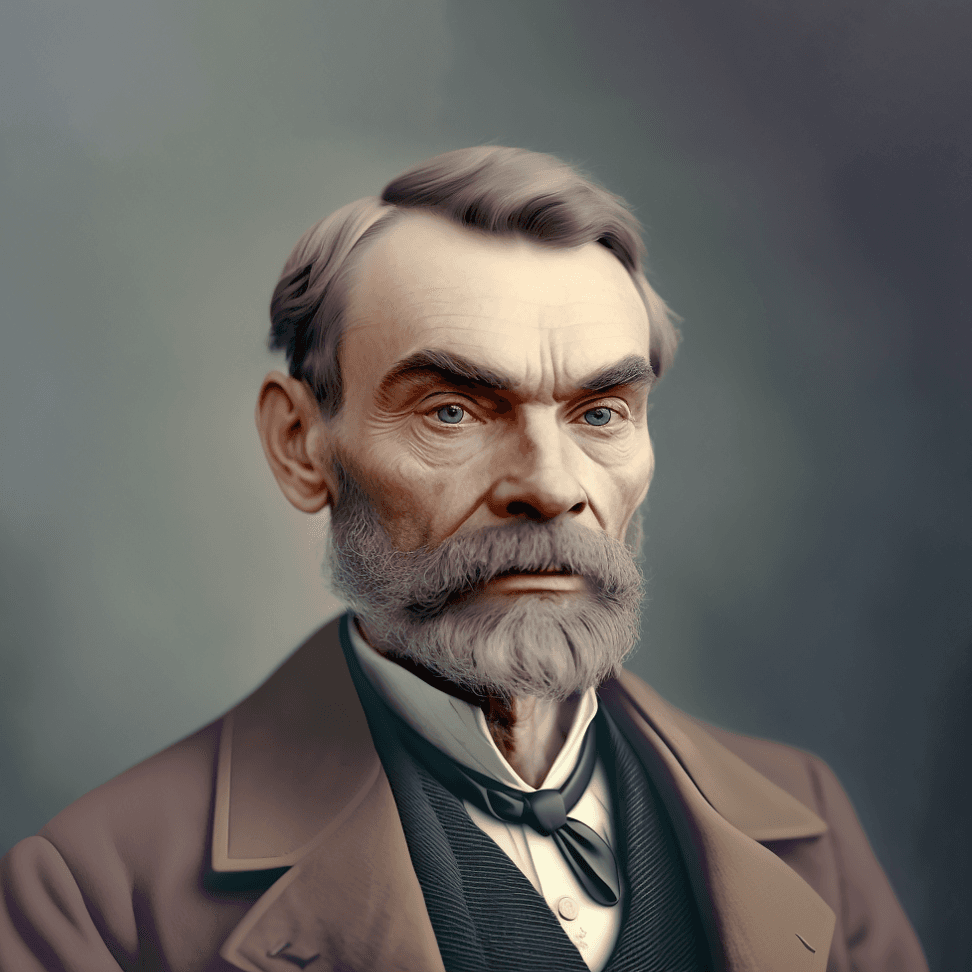
1833–1896
Inventor • Industrialist • Philanthropist
This is a read-only educational profile. Chat, Council Mode, and AI features are not available for historical figures.
Alfred Bernhard Nobel was born on 21 October 1833 in Stockholm into a family of engineers navigating Sweden's industrial modernization and Russia's demand for military technology. His father Immanuel Nobel moved the family to Saint Petersburg, where he manufactured mines and naval equipment for the tsarist government, exposing Alfred to factories, explosives, and multilingual business from youth. After Immanuel's bankruptcy forced return to Sweden, Alfred studied chemistry in Paris and the United States, working briefly under inventor John Ericsson and absorbing contemporary research on nitroglycerin. Nitroglycerin, discovered by Ascanio Sobrero, offered explosive power far exceeding black powder but proved dangerously unstable in transport and handling, causing laboratory and factory catastrophes across Europe. Nobel focused on taming this compound through systematic experiment rather than abandoning it, believing controlled high explosives could revolutionize mining, tunneling, and infrastructure. He held patents in multiple countries, spoke Swedish, Russian, French, German, and English, and maintained laboratories in Sweden, Germany, and later France and Italy. Personal life remained restrained: he never married, maintained long-distance relationships, and described himself in letters as a lonely itinerant among factories. Literature offered consolation; he wrote poetry and drama in private, a contrast to public identity as arms manufacturer that later shaped reactions to his will. By the 1860s Nobel was already wealthy yet haunted by the human cost of products that made his fortune possible.
In 1867 Nobel patented dynamite, mixing nitroglycerin with kieselguhr diatomaceous earth to create a stable, transportable explosive that could be packed in cartridges and detonated safely with blasting caps of his own design. The invention revolutionized mining, quarrying, railway construction, and canal digging while also supplying military arsenals seeking more efficient munitions. Nobel built a multinational enterprise with factories and laboratories across Europe, holding hundreds of patents for detonators, synthetic materials, artificial silk experiments, and armaments including ballistite propellants. Business required navigating patent disputes, nationalist regulations, and labor unrest at explosives plants where accidents remained frequent despite improved formulas. He lived much of his life abroad, moving between residences to supervise production and evade legal conflicts, yet remained emotionally tied to Swedish culture and correspondence with family. A premature 1888 obituary published in a French newspaper that condemned him as a merchant of death reportedly prompted deep reflection on how he wished to be remembered. On 27 November 1895, at the Swedish-Norwegian Club in Paris, Nobel signed a will allocating the bulk of his estate to prizes in physics, chemistry, physiology or medicine, literature, and peace. The document surprised relatives and governments; its legal validity faced challenges across jurisdictions before executors Ragnar Sohlman and Rudolf Lilljequist secured the foundation. Nobel's chemical laboratories continued refining explosives until his final illness, demonstrating how invention and destruction remained inseparable in his working life.
Nobel died on 10 December 1896 in San Remo, Italy, where he had wintered for health, and the first Nobel Prizes were awarded in 1901 after protracted estate settlement. The Nobel Foundation in Stockholm administered awards according to his instructions, transforming a weapons fortune into the world's most visible honor for discovery, creativity, and peace advocacy. Early laureates included Wilhelm Röntgen, Marie and Pierre Curie, and peace activists such as Bertha von Suttner, who had corresponded with Nobel and influenced his philanthropic turn. Dynamite and related technologies accelerated industrial modernity—Swiss tunnels, American railways, Panama excavation—while feeding modern warfare's destructive scale. The tension between constructive and destructive uses of Nobel's inventions remains central to how societies evaluate technological progress and moral responsibility. Economics Prize added later by Sweden's central bank extended the brand though it was not in Nobel's original will. Debates over omissions—mathematics, environmental science, colonial violence—recur annually when committees announce selections. Nobel's own poetry and failed romance narratives suggest he understood narrative legacy as carefully as chemical legacy. Global media now treat Nobel week as a calendar of scientific prestige and geopolitical signaling, especially for the Peace Prize. His life embodies the dual face of nineteenth-century industry: tools that carved railways and tunnels also fed modern warfare, and one man's will attempted to redirect wealth from destruction toward recognition of knowledge and peace. Engineers memorialized Nobel in monument inscriptions at tunnel openings from the Alps to the Rockies, acknowledging explosives that made projects feasible at scale. Nobel's correspondence with Bertha von Suttner on disarmament ideals shows philanthropic evolution alongside industrial profit. Archivists in Stockholm maintain his laboratory notebooks, allowing historians to trace iterative chemical adjustments preceding dynamite stabilization. Annual Nobel broadcasts remain appointment viewing for scientists and diplomats gauging global recognition of discovery and peace efforts. Corporate historians at Dynamit Nobel AG document factory safety reforms spurred by nineteenth-century accidental explosions. Peace Prize ceremonies in Oslo continue to reference his will's wording when debating eligibility of mediators, journalists, and institutions in modern conflicts. Historians of philanthropy compare his will to other industrial fortunes redirected toward public good, analyzing how personal shame and legacy anxiety can reshape institutional prizes.
Key moments across this figure's life and legacy
1833
Born into an engineering family and educated in chemistry in Paris and the United States.
1867
Patented dynamite after years of experiments to stabilize nitroglycerin.
1888
Misreported death in a French newspaper reportedly spurred reconsideration of his public image.
1895
Signed the will establishing the Nobel Prizes, bequeathing most of his estate to the awards.
1896
Died in Italy; the first Nobel Prizes were awarded in 1901 after estate settlement.
Landmarks that define this figure's contribution to history
Invented a stabilized form of nitroglycerin that made explosives practical for industry and engineering.
Developed blasting caps and ignition methods that improved safety and reliability in explosive use.
Built an international network of factories and patents spanning Europe and beyond.
Bequeathed his fortune to establish annual prizes in science, literature, and peace.
How this figure shaped the world we inherit
Nobel embodied the dual face of nineteenth-century industry: explosives that carved railways and tunnels also fed modern warfare. His will redirected wealth from destruction toward recognition of knowledge and peace, creating an institution that influences scientific careers, literary reputations, and diplomatic history. The tension between dynamite's utility and its human cost remains central to how societies evaluate technological progress and moral responsibility.
Explore more profiles from the same era or field
Curated educational resources for further study
Discover historical art and educational content on our media channels