Jeet Kune Do
Founded a martial arts philosophy prioritizing efficiency, interception, and freedom from fixed styles.
Discover
Explore influential historical figures from science, philosophy, leadership, art, and culture.
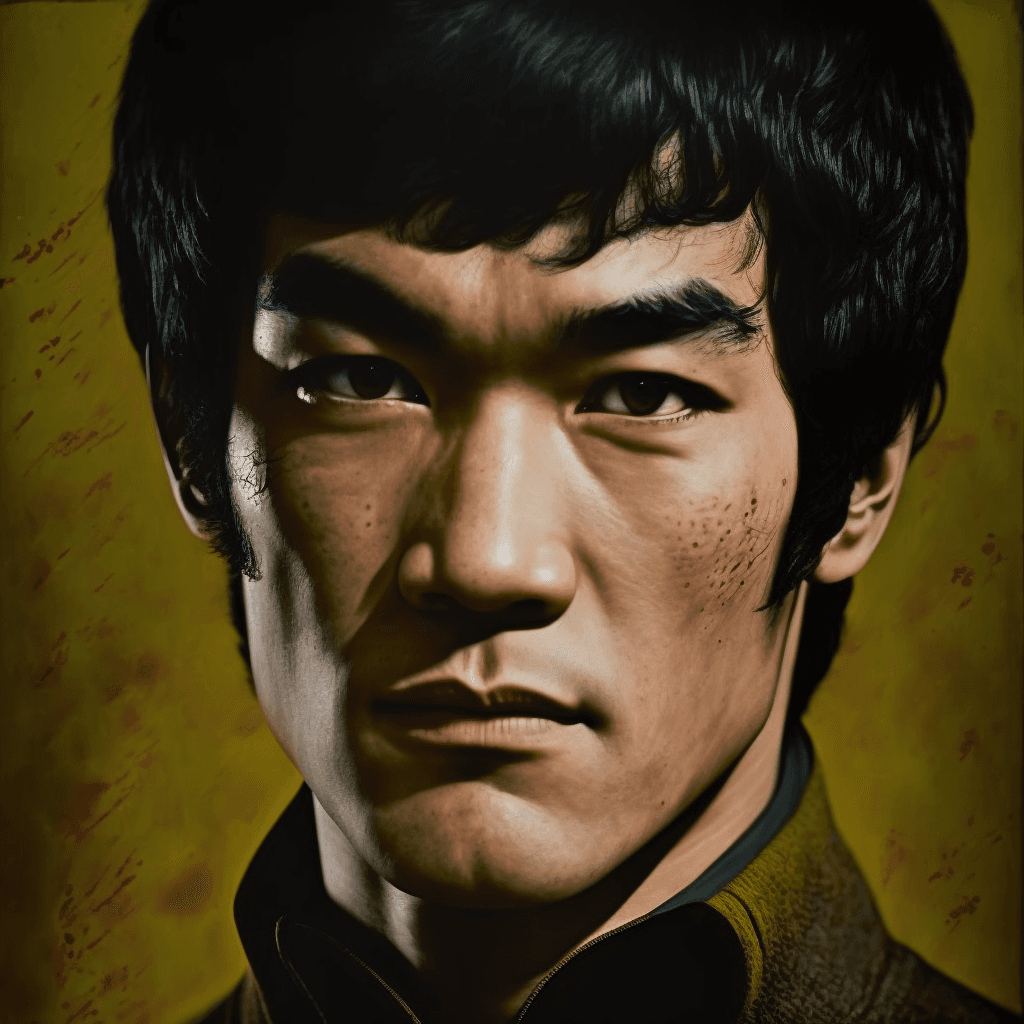
1940–1973
Martial Artist • Actor • Cultural Icon
This is a read-only educational profile. Chat, Council Mode, and AI features are not available for historical figures.
Bruce Lee was born Lee Jun-fan on 27 November 1940 in San Francisco's Chinatown while his parents toured with a Cantonese opera company; his father Lee Hoi-chuen was a well-known performer and his mother Grace Ho came from a prosperous Hong Kong family. Raised primarily in Hong Kong, Lee appeared in numerous films as a child actor, including roles under the name Little Dragon that later inspired his stage name. Street fights and disciplinary trouble at La Salle College led his parents to send him back to the United States in 1959, where he lived in Seattle, completed high school, and attended the University of Washington studying philosophy. In Hong Kong he studied wing chun under Ip Man, absorbing a close-range southern Chinese system emphasizing centerline theory and efficiency, though Ip Man's senior students sometimes questioned Lee's full initiation due to mixed heritage prejudices. Seattle life included teaching martial arts in parking lots and basements, working as a dance instructor— cha-cha competitions funded early teaching—and marrying Linda Emery in 1964 against her family's initial reservations. Lee's letters and essays from the period show fascination with existentialism, self-actualization, and breaking from traditional kung fu secrecy toward open instruction. Hollywood offered only stereotypical roles—the sidekick Kato in Green Hornet television series—while rejecting him for lead parts that went to white actors in Asian roles. Frustration with American casting racism pushed Lee back to Hong Kong in 1971, where Golden Harvest offered creative control unheard of in Los Angeles. His physique, speed, and charisma already attracted martial arts students in Oakland and Los Angeles, including celebrities Steve McQueen and James Coburn, who funded and studied with him.
In Seattle, Oakland, and Los Angeles, Lee developed Jeet Kune Do, a philosophy emphasizing adaptability, directness, interception, and rejection of rigid stylistic forms he compared to ornamental swimming without survival value. He wrote extensively in notebooks later published as Tao of Jeet Kune Do, arguing that truth in combat is found through personal expression rather than classical imitation. The Oakland challenge match against Wong Jack Man in 1964, whether mythologized or literal, reinforced Lee's conviction that traditional forms failed under full-contact pressure. Returning to Hong Kong, The Big Boss and Fist of Fury broke local box-office records, presenting Lee as avenger against colonial and criminal oppression with choreography faster than contemporaries. Way of the Dragon introduced Chuck Norris in Rome Colosseum fight, showcasing Lee's insistence on realistic timing and athleticism over wire tricks. Enter the Dragon, co-produced with Warner Bros., merged blaxploitation and kung fu tropes into a global crossover released in 1973 after his death, defining the genre for Western audiences. Lee directed portions, designed fights, and demanded cameras capture full-body movement rather than quick-cut deception common in some Hong Kong productions. Training regimens combined weightlifting, isometrics, and diet experiments unusual for Chinese martial artists of his era, prefiguring modern strength-and-conditioning culture. On set he corrected stunt teams personally, raising injury risks but achieving visual authenticity that influenced Jackie Chan, Jet Li, and later Hollywood action directors.
Lee died on 20 July 1973 in Hong Kong at thirty-two from cerebral edema linked to medication sensitivity, possibly compounded by heat and overwork; conspiracy theories persist though medical consensus favors adverse reaction to Equagesic. Enter the Dragon premiered weeks later, turning mourning into global legend. His physical speed, charisma, and insistence on authentic choreography altered action cinema from Hong Kong to Hollywood. Jeet Kune Do manuals and interviews circulated globally, shaping mixed martial arts discourse decades before the UFC normalized cross-training. Lee challenged Hollywood's emasculating stereotypes of Asian men, asserting intellectual and physical prowess in interviews with Pierre Berton and on American television. Statues in Hong Kong and Los Angeles, biopics, and posthumous completion films such as Game of Death fragments keep his image ubiquitous. Scholars note tensions between his anti-dogma philosophy and commercial legend-making, including merchandising and unauthorized schools claiming lineage. Mixed martial arts fighters cite him as conceptual ancestor for style integration; philosophers of sport analyze his writings on water and formlessness. Lee bridged Hong Kong and Hollywood, making martial arts a central vocabulary of global popular culture. By demanding dignified roles for Asian actors, he challenged racist casting norms whose effects still surface in contemporary film debates, ensuring his brief life carries disproportionate cultural weight. Martial arts historians document his student roster and training logs, showing systematic strength programming unusual in 1960s kung fu culture. Hong Kong Film Archive restorations highlight fight scenes cut for overseas censorship, recovering choreography later imitated worldwide. Disability and health researchers occasionally cite his back injury and convalescence as context for evolving fight philosophy emphasizing efficiency over exhibition. Action cinema textbooks assign Enter the Dragon as baseline for staging combat that respects actor athleticism and camera geography. University martial arts clubs study his interviews on water and adaptability as philosophical supplements to physical drill.
Key moments across this figure's life and legacy
1940
Born Lee Jun-fan during a family tour and raised primarily in Hong Kong.
1950s
Studied wing chun in Hong Kong under master Ip Man.
1967
Formalized his martial arts approach while teaching in Los Angeles.
1971
Achieved stardom in Hong Kong with a film that shattered local box-office records.
1973
Died suddenly in Kowloon at thirty-two before Enter the Dragon's release.
Landmarks that define this figure's contribution to history
Founded a martial arts philosophy prioritizing efficiency, interception, and freedom from fixed styles.
Starred in record-breaking films including The Big Boss and Way of the Dragon.
Completed a Hollywood co-production that became the definitive kung fu crossover film.
Introduced realistic, athletic combat staging that transformed international action direction.
How this figure shaped the world we inherit
Lee bridged Hong Kong and Hollywood, making martial arts a central vocabulary of global popular culture. His teaching emphasized personal liberation over tradition, prefiguring mixed martial arts and functional training cultures. By demanding dignified roles for Asian actors, he challenged racist casting norms whose effects still surface in contemporary film debates.
Explore more profiles from the same era or field
Curated educational resources for further study
Discover historical art and educational content on our media channels