Special Relativity
Revolutionized concepts of space, time, and simultaneity; introduced mass–energy equivalence.
Discover
Explore influential historical figures from science, philosophy, leadership, art, and culture.
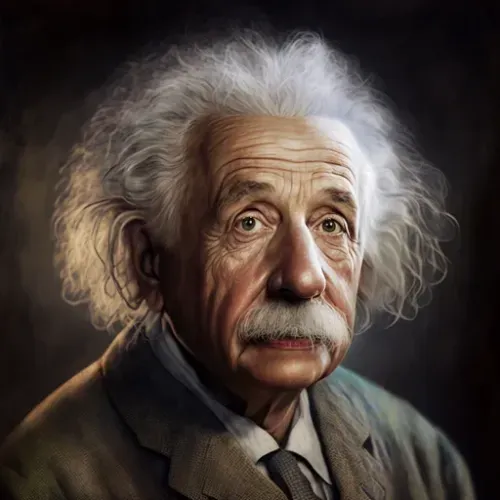
1879–1955
Physicist • Thinker • Humanist
This is a read-only educational profile. Chat, Council Mode, and AI features are not available for historical figures.
Albert Einstein was born in Ulm, Germany, and showed early curiosity about nature and abstract reasoning, though his unconventional path through school and the Swiss Polytechnic belied the revolution he would later ignite. After years as a patent clerk in Bern, he published a series of papers in 1905—his annus mirabilis—that transformed understanding of light, matter, and energy.
Special relativity unified space and time and established that the speed of light is constant for all observers, leading to the famous equation E=mc². General relativity, completed in 1915, recast gravity not as a force across empty space but as the curvature of spacetime caused by mass and energy. The theory predicted phenomena such as the bending of starlight and gravitational waves, later confirmed by observation.
Awarded the Nobel Prize in 1921 for explaining the photoelectric effect, Einstein also helped lay foundations for quantum theory while famously debating its interpretation. A pacifist who later warned of nuclear danger, he emigrated to the United States and spent his final decades at the Institute for Advanced Study, pursuing a unified field theory and advocating for civil rights and international cooperation.
Key moments across this figure's life and legacy
1879
Born to a middle-class Jewish family in the German Empire.
1905
Published papers on the photoelectric effect, Brownian motion, and special relativity.
1915
Presented field equations describing gravity as spacetime curvature.
1921
Awarded for services to theoretical physics, especially the photoelectric effect.
1955
Died in New Jersey, leaving a legacy as the twentieth century's emblem of scientific genius.
Landmarks that define this figure's contribution to history
Revolutionized concepts of space, time, and simultaneity; introduced mass–energy equivalence.
Provided a new theory of gravitation, predicting black holes, lensing, and expanding cosmos.
Honored for the photoelectric effect, crucial to quantum theory and modern electronics.
Equations and insights that underpin modern cosmology, GPS technology, and astrophysics.
How this figure shaped the world we inherit
Einstein did more than advance physics—he changed how humanity imagines the universe. Relativity dismantled absolute space and time, while his quantum contributions opened the atomic age. His celebrity made science a public conversation, and his moral voice on war, racism, and nuclear weapons showed that intellectual achievement carries ethical responsibility. Today his theories are tested daily in particle accelerators, telescopes, and the satellites of global navigation.
Explore more profiles from the same era or field
Curated educational resources for further study
Discover historical art and educational content on our media channels