Telescopic Discoveries
Observed Jupiter's moons and Venus's phases, supporting heliocentric astronomy.
Discover
Explore influential historical figures from science, philosophy, leadership, art, and culture.
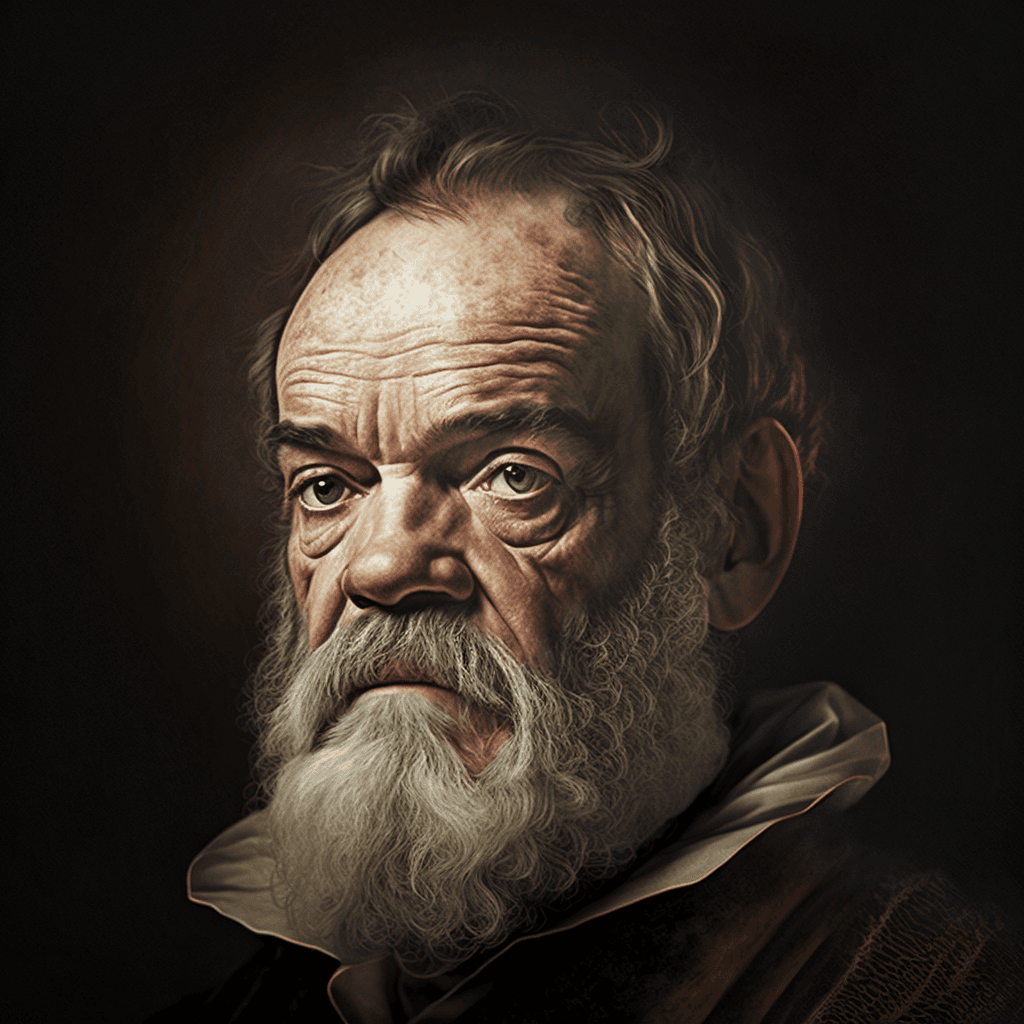
1564-1642
Astronomer - Physicist - Experimental Pioneer
This is a read-only educational profile. Chat, Council Mode, and AI features are not available for historical figures.
Galileo Galilei was born in Pisa and came of age in an Italy alive with artistic and scientific experimentation. Although he initially studied medicine, he shifted toward mathematics and natural philosophy, eventually teaching in Pisa and Padua. His work challenged inherited scholastic explanations by demanding measurable evidence and reproducible demonstration.
In 1609 Galileo improved the telescope and turned it toward the sky, discovering lunar mountains, Jupiter's moons, phases of Venus, and countless new stars. These findings weakened geocentric cosmology and gave strong observational support to Copernican heliocentrism. In mechanics, he studied falling bodies, inertia, and pendular motion, establishing methods that linked mathematics with systematic experiment.
Galileo's defense of heliocentrism brought him into conflict with ecclesiastical authorities, culminating in his 1633 trial and house arrest. Even under restriction, he continued writing and circulated foundational ideas in kinematics and material strength. Later generations called him a father of modern science because he fused instrument-based observation, quantitative reasoning, and skepticism toward authority into a durable scientific practice.
Key moments across this figure's life and legacy
1564
Born in the Duchy of Florence during the Italian Renaissance.
1609
Adapted Dutch designs into a more powerful astronomical instrument.
1610
Announced major telescopic discoveries to the European scholarly world.
1633
Tried for defending heliocentric claims and sentenced to house arrest.
1642
Died after completing late work on motion and mechanics.
Landmarks that define this figure's contribution to history
Observed Jupiter's moons and Venus's phases, supporting heliocentric astronomy.
Quantified motion of falling bodies and accelerated movement with mathematical methods.
Published observations that transformed European understanding of the heavens.
Promoted controlled experiment and measurement as core scientific tools.
How this figure shaped the world we inherit
Galileo helped redirect science from textual authority to empirical verification. His telescopic findings changed cosmology, while his experiments on motion shaped the mechanical worldview later formalized by Newton. Beyond specific discoveries, his career established the social and intellectual template of the modern scientist: instrument builder, data interpreter, and public defender of evidence in the face of institutional resistance.
Explore more profiles from the same era or field
Curated educational resources for further study
Discover historical art and educational content on our media channels