Nobel Prize for Quantum Electrodynamics
Shared the 1965 prize for renormalizing QED and inventing diagrammatic techniques that became standard across particle physics.
Discover
Explore influential historical figures from science, philosophy, leadership, art, and culture.
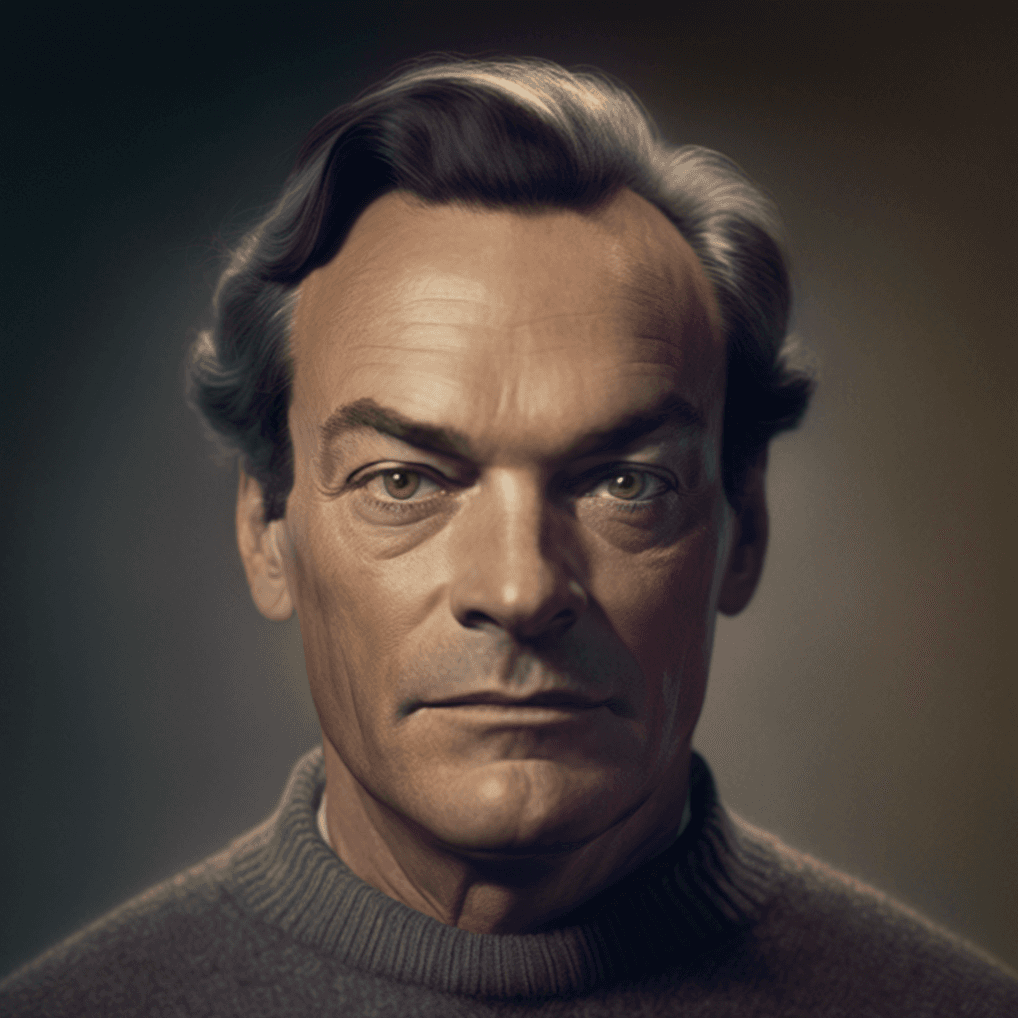
1918–1988
Physicist • Nobel Laureate • Educator
This is a read-only educational profile. Chat, Council Mode, and AI features are not available for historical figures.
Born in 1918 in Queens, New York, Richard Phillips Feynman showed early genius in mathematics and tinkering, fixing radios and building home laboratories. At Princeton he worked on the Manhattan Project under Hans Bethe, developing calculation methods while witnessing the birth of the atomic age at Los Alamos.
After the war, Feynman revolutionized theoretical physics with his path-integral formulation and Feynman diagrams, tools that simplified quantum electrodynamics and earned him the Nobel Prize alongside Julian Schwinger and Sin-Itiro Tomonaga. At Caltech he delivered undergraduate lectures later published as *The Feynman Lectures on Physics*, still widely used decades later.
Beyond equations, Feynman pursued safecracking at Los Alamos, bongo drumming, and painting. His plain-spoken skepticism shone during the 1986 Challenger inquiry, when he demonstrated O-ring failure in ice water on television. He died in 1988, remembered as a physicist who insisted that if you cannot explain something simply, you do not yet understand it.
Key moments across this figure's life and legacy
1918
Raised by immigrant parents who encouraged curiosity; taught himself advanced mathematics as a teenager.
1942
Recruited to Los Alamos, where he developed calculation shortcuts and became known for safecracking and pranks.
1965
Honored for fundamental work in quantum electrodynamics alongside Schwinger and Tomonaga.
1986
Demonstrated shuttle O-ring vulnerability on television, cutting through bureaucratic obfuscation.
1988
Died in Los Angeles; his memoirs and lectures continue to inspire scientists and general readers alike.
Landmarks that define this figure's contribution to history
Shared the 1965 prize for renormalizing QED and inventing diagrammatic techniques that became standard across particle physics.
His Caltech course, published in three volumes, remains one of the most influential physics textbooks ever written.
Led a theoretical division group at Los Alamos and developed computational methods critical to bomb design and safety.
Identified O-ring failure in cold weather on the Rogers Commission, demonstrating scientific integrity in public testimony.
How this figure shaped the world we inherit
Feynman made quantum physics intelligible to students and the public without sacrificing rigor, reshaping science communication for the television age. His diagrams and pedagogical methods remain embedded in physics education, while his insistence on honest inquiry influenced how institutions investigate technological failure.
Explore more profiles from the same era or field
Curated educational resources for further study
Discover historical art and educational content on our media channels