Telescopic Discoveries
Observed Jupiter's moons and Venus's phases, supporting heliocentric astronomy.
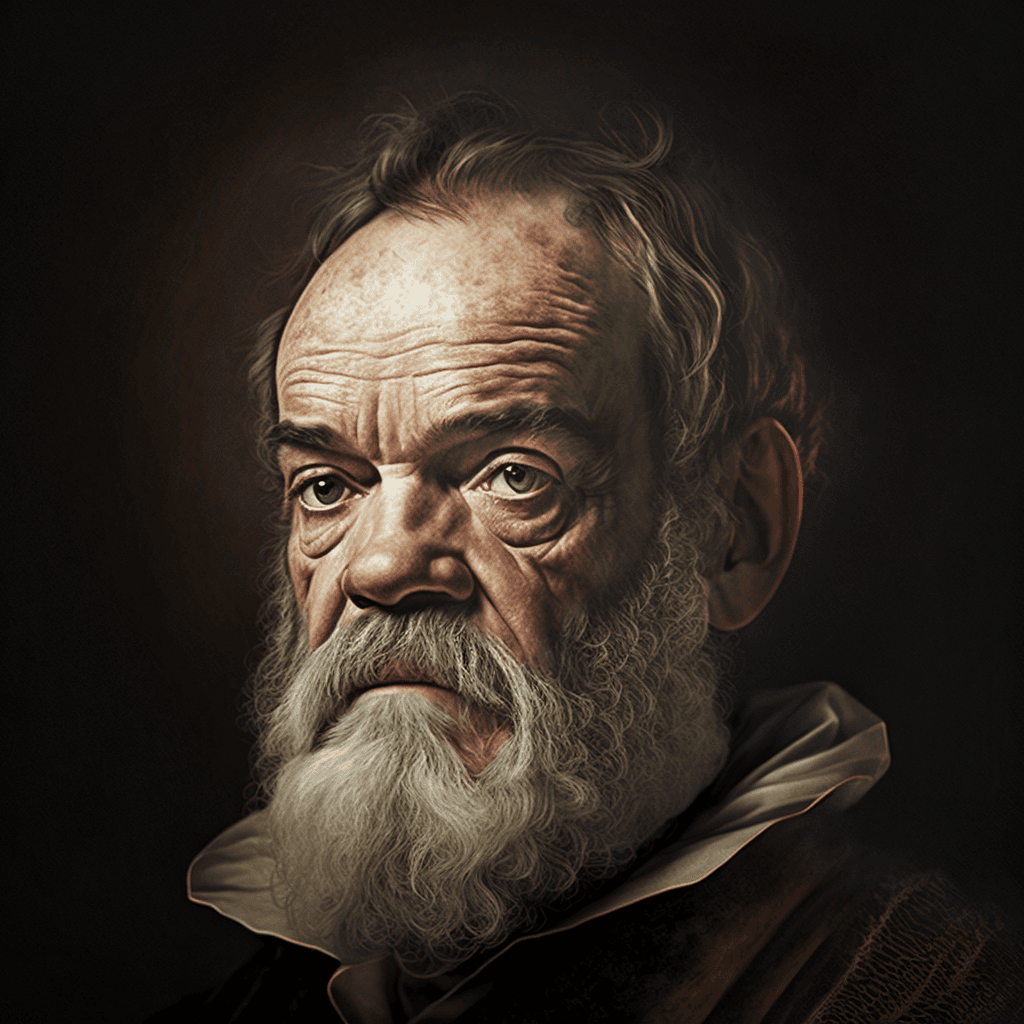
1564-1642
Astronomer - Physicist - Experimental Pioneer
Galileo Galilei nació en Pisa y alcanzó la madurez en una Italia llena de experimentación artística y científica. Aunque inicialmente estudió medicina, se inclinó hacia las matemáticas y la filosofía natural, enseñando eventualmente en Pisa y Padua. Su trabajo desafió las explicaciones escolásticas heredadas al exigir evidencia medible y demostraciones reproducibles.
En 1609, Galileo mejoró el telescopio y lo dirigió hacia el cielo, descubriendo montañas lunares, las lunas de Júpiter, las fases de Venus y innumerables estrellas nuevas. Estos hallazgos debilitaron la cosmología geocéntrica y brindaron un fuerte apoyo observacional al heliocentrismo copernicano. En mecánica, estudió los cuerpos en caída, la inercia y el movimiento pendular, estableciendo métodos que vinculaban las matemáticas con la experimentación sistemática.
La defensa de Galileo del heliocentrismo lo llevó a un conflicto con las autoridades eclesiásticas, culminando en su juicio de 1633 y arresto domiciliario. Incluso bajo restricción, continuó escribiendo y difundió ideas fundamentales en cinemática y resistencia de materiales. Las generaciones posteriores lo llamaron padre de la ciencia moderna porque fusionó la observación basada en instrumentos, el razonamiento cuantitativo y el escepticismo hacia la autoridad en una práctica científica duradera.
Momentos clave en la vida y el legado de esta figura
1564
Born in the Duchy of Florence during the Italian Renaissance.
1609
Adapted Dutch designs into a more powerful astronomical instrument.
1610
Announced major telescopic discoveries to the European scholarly world.
1633
Tried for defending heliocentric claims and sentenced to house arrest.
1642
Died after completing late work on motion and mechanics.
Hitos que definen la contribución de esta figura a la historia
Observed Jupiter's moons and Venus's phases, supporting heliocentric astronomy.
Quantified motion of falling bodies and accelerated movement with mathematical methods.
Published observations that transformed European understanding of the heavens.
Promoted controlled experiment and measurement as core scientific tools.
Detalles notables sobre esta figura
Cómo esta figura moldeó el mundo que heredamos
Galileo ayudó a redirigir la ciencia de la autoridad textual a la verificación empírica. Sus hallazgos telescópicos cambiaron la cosmología, mientras que sus experimentos sobre el movimiento moldearon la visión mecánica que luego fue formalizada por Newton. Más allá de descubrimientos específicos, su carrera estableció el modelo social e intelectual del científico moderno: constructor de instrumentos, intérprete de datos y defensor público de la evidencia frente a la resistencia institucional.
Influencia duradera a través de generaciones
Galileo helped redirect science from textual authority to empirical verification. His telescopic findings changed cosmology, while his experiments on motion shaped the mechanical worldview later formalized by Newton. Beyond specific discoveries, his career established the social and intellectual template of the modern scientist: instrument builder, data interpreter, and public defender of evidence in the face of institutional resistance. Death near Florence (1642) remains a defining moment in Galileo Galilei's enduring reputation.
Más perfiles de la misma época o campo
Recursos educativos seleccionados para profundizar
Inicia una conversación privada con Historical Collection AI.