Laws of Motion
Three principles forming the foundation of classical mechanics and engineering.
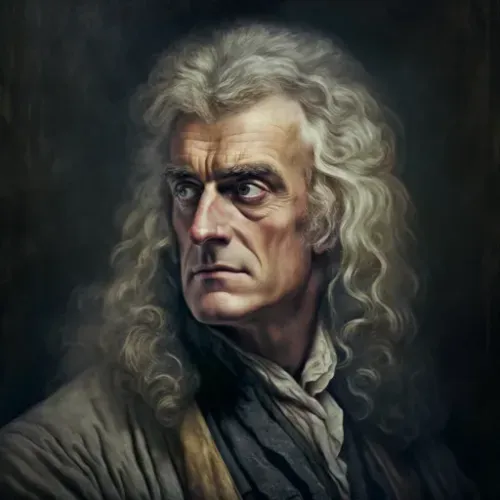
1643–1727
Mathematician • Physicist • Astronomer
Isaac Newton nació en Woolsthorpe, Inglaterra, en medio de la agitación de la guerra civil y la Revolución Científica. Estudiante solitario e intensamente concentrado, ingresó a la Universidad de Cambridge y más tarde soportó los años de peste desarrollando los fundamentos del cálculo y realizando experimentos sobre la luz. Su genialidad combinó la abstracción matemática con la convicción de que las leyes de la naturaleza podían leerse a través de la observación y la medición.
En 1687 publicó Philosophiæ Naturalis Principia Mathematica, presentando tres leyes del movimiento y la ley de la gravitación universal. El Principia mostró que la misma fuerza que rige la caída de una manzana también gobierna la órbita de la Luna, unificando la mecánica terrestre y celeste. El trabajo de Newton sobre óptica demostró que la luz blanca comprende un espectro de colores, desafiando las teorías predominantes.
Caballero y nombrado Maestro de la Casa de la Moneda, Newton también persiguió la alquimia y la teología—campos que revelan la amplitud de sus indagaciones. Aunque los físicos posteriores revisaron su marco, especialmente a velocidades y escalas extremas, la mecánica newtoniana se convirtió en la base de la ingeniería, la astronomía y el pensamiento de la Ilustración, ganándose un lugar entre las mentes más influyentes de la historia.
Momentos clave en la vida y el legado de esta figura
1643
Born prematurely in Lincolnshire; his father died before his birth.
1665–1666
During plague closures, advanced calculus, optics, and gravitation ideas.
1687
Released Mathematical Principles of Natural Philosophy, reshaping science.
1704
Published major work on light, color, and experimental method.
1727
Buried in Westminster Abbey as a national hero of the Enlightenment.
Hitos que definen la contribución de esta figura a la historia
Three principles forming the foundation of classical mechanics and engineering.
Showed that all masses attract one another, explaining planetary orbits and tides.
Developed infinitesimal calculus independently, enabling modern mathematical physics.
Landmark 1687 treatise that systematized natural philosophy for generations.
Detalles notables sobre esta figura
Cómo esta figura moldeó el mundo que heredamos
La síntesis de Newton de matemáticas y física proporcionó a la Ilustración un modelo de un universo racional y regido por leyes. Los ingenieros construyeron la Revolución Industrial sobre su mecánica; los astrónomos mapearon el sistema solar con su gravitación; los filósofos lo citaron como prueba de que la razón humana podía descifrar la naturaleza. Incluso después de Einstein, Newton sigue siendo esencial para la mayoría de las ciencias cotidianas—desde el diseño de puentes hasta las trayectorias de vuelos espaciales.
Influencia duradera a través de generaciones
Newton's synthesis of mathematics and physics gave the Enlightenment a model of a rational, law-governed universe. Engineers built the Industrial Revolution on his mechanics; astronomers mapped the solar system with his gravitation; philosophers cited him as proof that human reason could decode nature. Even after Einstein, Newton remains essential for most everyday science—from bridge design to spaceflight trajectories. Death in London (1727) remains a defining moment in Isaac Newton's enduring reputation.
Más perfiles de la misma época o campo
Recursos educativos seleccionados para profundizar
Inicia una conversación privada con Historical Collection AI.