Suspense Technique
Developed visual and narrative methods—MacGuffins, point-of-view editing, and delayed revelation—that defined the thriller genre.
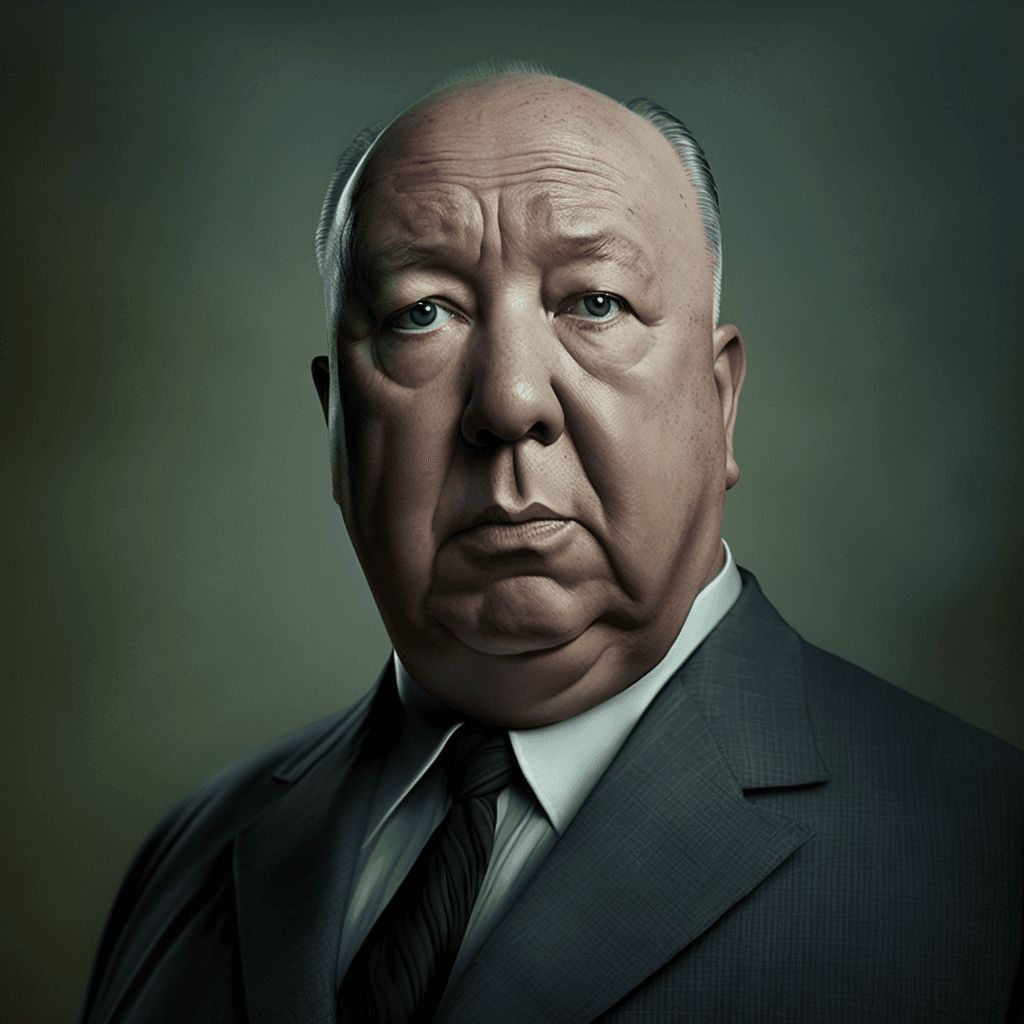
1899–1980
Director • Master of Suspense
Alfred Joseph Hitchcock was born on 13 August 1899 in Leytonstone, East London, the son of a greengrocer and a poultry dealer's daughter, and was educated by Jesuits at St Ignatius College in Stamford Hill. A formative episode—his father sending him to a police station with a note instructing officers to hold him briefly—later fed his fascination with guilt, surveillance, and arbitrary authority. Hitchcock entered the film industry in the 1920s as a title designer and art director at Islington studios, where German Expressionist visual habits and British commercial discipline converged. He rose quickly as a director in Britain, learning economy, montage, and the manipulation of audience expectation through thrillers such as The Lodger and Blackmail, often cited as among the first British talkies. Marriage to Alma Reville, a skilled editor and script consultant, provided a lifelong creative partnership that shaped pacing and continuity across his filmography. Hitchcock's Catholic upbringing and Edwardian London childhood supplied recurring motifs: wrongful accusation, moral panic, blonde heroines, and ordinary people plunged into extraordinary danger. He studied Walter Murnau and Fritz Lang, absorbed Soviet montage theory, and read widely in crime fiction, translating literary suspense into purely cinematic terms. By the mid-1930s British critics recognized him as a major talent, and Hollywood studios watched his work closely as Europe drifted toward war. His public persona—dry humor, rotund silhouette, precise diction—began forming even before American fame, preparing audiences to see the director as orchestrator of fear.
In films such as The 39 Steps, Rebecca, Notorious, Rear Window, Vertigo, and Psycho, Hitchcock treated the camera as an active participant in fear rather than a neutral recorder. He favored ordinary settings invaded by danger, wrong-man narratives, MacGuffins that motivate plot while defying logical necessity, and editing patterns that align viewer complicity with character anxiety. Moving to Hollywood in 1939 under contract with David O. Selznick, he adapted Daphne du Maurier's Rebecca into an Oscar-winning gothic romance that established his American reputation. Subsequent decades at Paramount, Warner Bros., and his own production arrangements allowed increasing control over storyboards, casting, and publicity campaigns. Rear Window transformed a single apartment vista into a moral laboratory about voyeurism; Vertigo pursued obsession through color design and a dizzying zoom effect that mimicked psychological disorientation. Psycho, filmed in black and white on a modest budget in 1960, violated narrative expectations by killing its apparent protagonist early and presenting shower violence through rapid montage rather than explicit gore. The film altered Hollywood censorship practices and horror conventions, demonstrating that television-trained audiences would accept radical formal breaks in mainstream exhibition. Hitchcock collaborated closely with composer Bernard Herrmann, title designer Saul Bass, and cinematographers including Robert Burks, integrating music and graphics into his brand. Television's Alfred Hitchcock Presents extended his persona to millions of households through the 1950s and 1960s, normalizing short-form suspense and his sardonic host introductions.
Critics associated with Cahiers du Cinéma later elevated Hitchcock from entertainer to auteur, analyzing Vertigo and Psycho as profound studies of obsession, identity, and male gaze. French New Wave directors acknowledged debts to his visual grammar; Truffaut's book-length interview remains a canonical text of film studies. Hitchcock received the AFI Life Achievement Award in 1979 and was knighted shortly before death, a capstone to career spanning silent era through New Hollywood. He died on 29 April 1980 in Los Angeles, leaving unfinished projects and a template for suspense cinema directors worldwide still emulate. Biographers have explored his complex relationships with actresses and his controlling directorial methods, adding ethical layers to aesthetic admiration. Academic programs routinely screen his work to teach point-of-view editing, sound design, and the economics of star casting. From blockbusters to art-house revivals, cinema's grammar of suspense—what viewers see, what they fear, and what remains hidden—owes an enduring debt to his British precision and Hollywood scale. Restoration of Vertigo and reevaluation of its themes of manipulation and trauma cemented its place atop international greatest-films lists. Hitchcock demonstrated that popular entertainment could carry formal rigor and psychological depth without sacrificing box-office accessibility. His influence extends to video games, streaming thrillers, and advertising techniques that exploit anticipation and off-screen space. Film preservation archives restored silent-era Hitchcock titles, revealing continuity of motifs from British period through Hollywood color films. Storyboard sketches auctioned after his death confirmed meticulous previsualization of sequences audiences experienced as spontaneous suspense. Contemporary filmmakers study his restraint with violence and sound, noting how off-screen space often terrifies more than explicit depiction. Museum retrospectives from London to Melbourne pair his work with painters and photographers who shared his obsession with voyeurism and composed unease. Academic syllabi pair Psycho with Victorian sensation fiction to trace long genealogy of domestic dread in popular narrative forms. The British Film Institute's restored prints allow new generations to study his silent-era montage techniques alongside sound-era masterpieces in single retrospectives. Streaming algorithms recommend his titles to thriller audiences decades after release, evidence that suspense techniques he codified remain commercially durable across changing exhibition platforms.
1899 — Born in Leytonstone. Born in East London and educated at St Ignatius College under Jesuit discipline.
1925 — Directorial Debut. Directed The Pleasure Garden in Germany, beginning his career as a filmmaker.
1939 — Hollywood Relocation. Moved to the United States and signed with David O. Selznick for Rebecca.
1960 — Psycho Released. Premiered a low-budget thriller that became his most culturally cited work.
1980 — Death in Los Angeles. Died in Bel Air after receiving the AFI Life Achievement Award the prior year.
Key moments across this figure's life and legacy
1899
Born in East London and educated at St Ignatius College under Jesuit discipline.
1925
Directed The Pleasure Garden in Germany, beginning his career as a filmmaker.
1939
Moved to the United States and signed with David O. Selznick for Rebecca.
1960
Premiered a low-budget thriller that became his most culturally cited work.
1980
Died in Bel Air after receiving the AFI Life Achievement Award the prior year.
Landmarks that define this figure's contribution to history
Developed visual and narrative methods—MacGuffins, point-of-view editing, and delayed revelation—that defined the thriller genre.
Directed a 1960 film whose shower sequence and narrative shocks altered Hollywood censorship and horror conventions.
Created a complex study of obsession and identity now widely ranked among the greatest films ever made.
Hosted Alfred Hitchcock Presents, bringing short-form suspense to mass audiences through the 1950s and 1960s.
Notable details about this historical figure
How this figure shaped the world we inherit
Hitchcock taught filmmakers that popular entertainment could carry formal rigor and psychological depth. His control of editing, sound, and audience complicity shaped horror, espionage, and psychological drama across continents. From blockbusters to art-house revivals, cinema's grammar of suspense—what viewers see, what they fear, and what remains hidden—owes an enduring debt to his British precision and Hollywood scale.
Enduring influence across generations
Hitchcock taught filmmakers that popular entertainment could carry formal rigor and psychological depth. His control of editing, sound, and audience complicity shaped horror, espionage, and psychological drama across continents. From blockbusters to art-house revivals, cinema's grammar of suspense—what viewers see, what they fear, and what remains hidden—owes an enduring debt to his British precision and Hollywood scale. Death in Los Angeles (1980) remains a defining moment in Alfred Hitchcock's enduring reputation.
Explore more profiles from the same era or field
Curated educational resources for further study
Start a private conversation and explore their wisdom through Historical Collection AI.