On the Waterfront
Brando's Terry Malloy—'I coulda been a contender'—won the Academy Award and exemplified method acting on film.
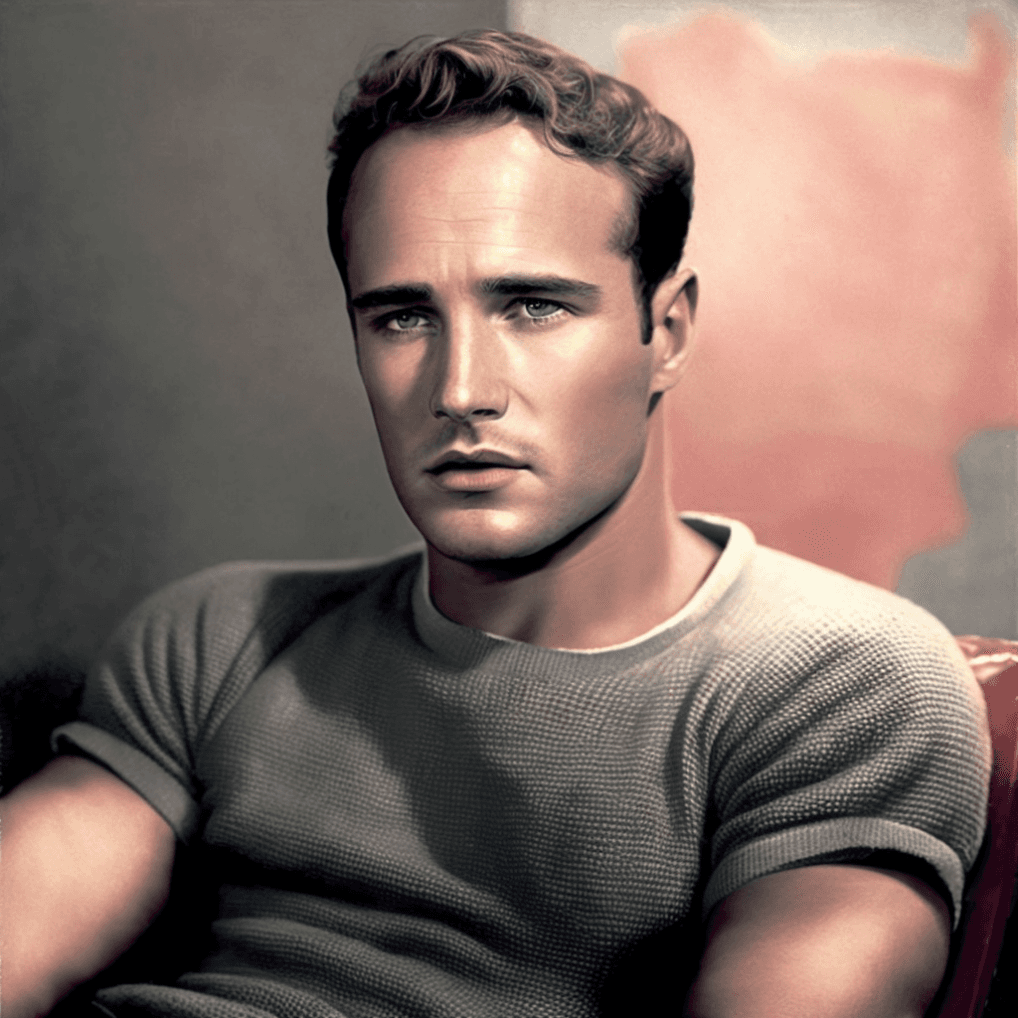
1924–2004
Actor • Method Acting Pioneer
Marlon Brando was born in 1924 in Omaha, Nebraska, to alcoholic parents; he was raised partly in Illinois. After expulsion from a military academy, he studied with Stella Adler in New York and joined the Actors Studio, where method training emphasized memory, sense, and subtext. His Broadway performance as Stanley Kowalski in A Streetcar Named Desire (1947) shocked audiences with its muscular realism.
Hollywood stardom followed. Brando earned acclaim in The Men, A Streetcar Named Desire (1951), and On the Waterfront (1954), where his portrayal of Terry Malloy's moral awakening became a template for modern film acting. He won a second Oscar for The Godfather (1972) as Vito Corleone but sent activist Sacheen Littlefeather to refuse the award in protest of Hollywood's treatment of Native Americans. Later roles in Last Tango in Paris and Apocalypse Now displayed both brilliance and controversy.
Brando's politics, weight fluctuations, and reclusiveness fed tabloid legend, yet generations of actors cite his example. He died in 2004 in Los Angeles, having transformed performance from declamatory style to inward, embodied truth.
1924 — Birth in Omaha. Brando grew up in the Midwest before moving to New York to pursue acting against his father's wishes.
1947 — Streetcar on Broadway. His Stanley Kowalski opposite Jessica Tandy's Blanche DuBois electrified theater critics and ticket sales.
1954 — Oscar for Waterfront. Brando won his first Academy Award for playing a dockworker who testifies against corrupt union bosses.
1973 — Oscar Refusal. He declined the Godfather award and sent Littlefeather to protest Native American portrayals in film and at Wounded Knee.
2004 — Death in Los Angeles. Brando died at eighty from respiratory failure, mourned as one of cinema's most transformative performers.
Key moments across this figure's life and legacy
1924
Brando grew up in the Midwest before moving to New York to pursue acting against his father's wishes.
1947
His Stanley Kowalski opposite Jessica Tandy's Blanche DuBois electrified theater critics and ticket sales.
1954
Brando won his first Academy Award for playing a dockworker who testifies against corrupt union bosses.
1973
He declined the Godfather award and sent Littlefeather to protest Native American portrayals in film and at Wounded Knee.
2004
Brando died at eighty from respiratory failure, mourned as one of cinema's most transformative performers.
Landmarks that define this figure's contribution to history
Brando's Terry Malloy—'I coulda been a contender'—won the Academy Award and exemplified method acting on film.
His quiet, physical portrayal of Vito Corleone redefined the gangster genre and earned a second Oscar for Best Actor.
As Stanley Kowalski on stage and screen, he brought Stanislavski-based realism to mass audiences.
Training with Adler and the Actors Studio, Brando made naturalistic performance the dominant standard in American theater and cinema.
Notable details about this historical figure
How this figure shaped the world we inherit
Brando shifted film acting from polished elocution to psychologically grounded behavior, influencing performers from James Dean to Daniel Day-Lewis. His career also intersected with civil rights activism and changing expectations of celebrity privacy.
Enduring influence across generations
Brando shifted film acting from polished elocution to psychologically grounded behavior, influencing performers from James Dean to Daniel Day-Lewis. His career also intersected with civil rights activism and changing expectations of celebrity privacy. Death in Los Angeles (2004) remains a defining moment in Marlon Brando's enduring reputation.
Explore more profiles from the same era or field
Curated educational resources for further study
Start a private conversation and explore their wisdom through Historical Collection AI.